

Mission Control | Student Success Systems
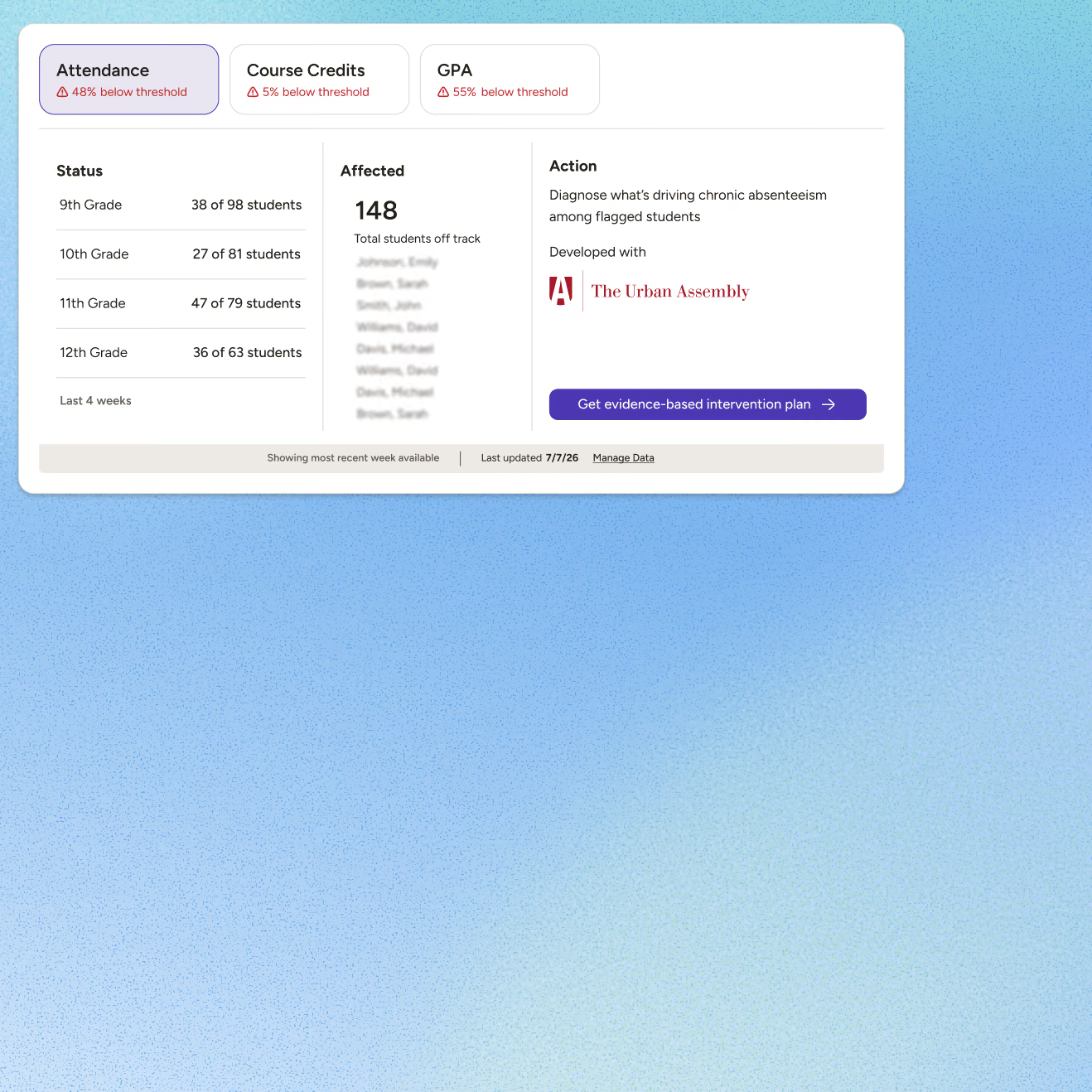
Schools have more data than ever, but finding the time to make sense of it is another story. Mission Control brings information about attendance, grades, credits, and other measures together in one place, making it easier to see which students need support and where larger trends may be emerging. With an AI assistant, educators can ask questions about their data, explore what might be happening, and find research-backed strategies to help students succeed.
11th Grade Credit Accumulation: Trends, Risks & Theory of Action
A consultative data report for the principal and leadership team, examining credit accumulation patterns, Regents performance, attendance trends, and a coordinated theory of action for the Class of 2027.
Executive Summary
72 11th graders. 17 off-track. Algebra is the biggest Regents barrier. Chronic absenteeism and LEP status are the compounding factors that connect every other indicator in this report.



The hard part is knowing which information matters, seeing patterns across data points, and turning what you see into action. Mission Control centers the research-backed early warning and on-track indicators tied to high school graduation. The purpose is not to flag students as “at risk.” It is to notice changes early, understand patterns across students and groups, and ask what adults and systems can do differently.
The technology is not the intervention. It helps educators get to the work of intervention faster. Strong Student Success Systems depend on strong teams, trusting relationships with students, and good routines for using data. Mission Control takes the burden of assembling and navigating data off the team.
At The Urban Assembly, early warning indicators are most powerful when they help educators move from reacting to individual student challenges to improving the systems that support student success. Identifying a student or trend is only the beginning: teams examine patterns across students and groups, ask what the data is telling them, and connect those insights to action.
The Urban Assembly’s Continuous Improvement Team →Mission Control brings attendance, course performance, GPA, credits, and on-track status together in one place, at the student and group level.
An AI assistant lets the team ask questions of its own data, investigate patterns, prioritize needs, and find research-backed interventions.
Less time pulling and organizing data. More time acting on what matters.
All your data, one place
See attendance, grades, credits, and other important information together instead of navigating multiple systems.
Ask questions. Find answers. Take action.
Use AI to explore trends, understand where students need support, and identify strategies to try.
See the student and the bigger picture
Identify individual students who need support while uncovering trends that may call for broader changes.
Spot challenges sooner
Notice early signs that students may be struggling and respond before they fall further behind.
A team notices ninth-grade attendance has slipped. Attendance, grades, credits, and on-track status sit together, so the signal is visible without pulling extra reports.
They ask the assistant whether the drop is concentrated in particular students or groups, and how it connects to course performance.
They prioritize where attention is needed, explore research-backed approaches, and decide on a response for individual students and the group, then keep watching the indicators to see whether it is working.

“We want to save teams time so they can ask better questions, uncover what is happening, and create space for planning.”
“We care primarily about our ability to improve outcomes for young people. We believe this tool can help us do that more effectively.”
About the evidence. Schools implementing Student Success Systems through the GRAD Partnership have shown meaningful improvements, including reductions in chronic absenteeism and course failure that grew over multiple years.
That research supports the approach, not the technology on its own. Paired with strong implementation and coaching, Mission Control makes the cycle from data to action faster.
Grade teams, counselors, and school leaders who review attendance, course performance, and on-track status together and want the meeting to be about decisions, not data pulls.
Schools focused on ninth grade, where attendance, course performance, and credit accumulation are the earliest signals of whether students stay on track to graduate.
Leaders supporting Student Success Systems across several schools, who want every team working from the same clear picture.
With The Urban Assembly’s Continuous Improvement Team
Learn how Student Success Systems and Mission Control work together, from early warning indicators to the routines that turn them into action.
Connect with The Urban Assembly and Lirvana Labs to explore how Mission Control and Student Success Systems can support your school’s goals.


COPPA, FERPA, and ERMA Certified




© 2026 Lirvana Labs Inc. All rights reserved.
